
Work With a Compliance Partner
FMCSA rules are becoming more complex. Partnering with a compliance expert like DOT Compliance Group can help you manage registration, reporting, and ongoing changes—so nothing falls through the cracks.
Get Support with FMCSA Compliance
Tools and Resources for Easy FMCSA Filing
Drug & Alcohol Clearinghouse
The Clearinghouse is required for all DOT-regulated employers and drivers. It’s used for pre-employment and annual queries, reporting violations, and follow-up testing
Internal Compliance Checklists
Maintaining your own checklists for inspections, driver qualification files, and drug and alcohol testing requirements can help ensure nothing is missed throughout the year.
Compliance Support Services
Working with DOT Compliance Group, a trusted compliance partner, can streamline filings, reporting, and monitoring. Expert support helps take the guesswork out of FMCSA regulations and keeps your operation audit-ready year-round.
Common Mistakes to Avoid with New FMCSA Rules
As FMCSA rules continue to change, violations can happen to carriers because of simple, avoidable mistakes. Here are some of the most common to watch out for:
- Relying on Outdated Information
Using old guidance, expired forms, or outdated processes can quickly put you out of compliance. - Overlooking English Proficiency Enforcement
Drivers not demonstrating reading/speaking ability may be placed out of service. - Poor Documentation and Digital Transition Errors
Migrate maintenance, driver, and safety documents to FMCSA-approved digital platforms and devices.
The FMCSA recently made changes to its rules to further enforce safety in the transportation and trucking industry. Learn more about it here.
Updating rules and federal regulations is crucial for the trucking and commercial motor vehicle industries to ensure safety, efficiency, and compliance with evolving technologies and industry practices.
The Federal Motor Carrier Safety Administration (FMCSA) plays a vital role in setting and enforcing these regulations to promote a safer transportation environment. Early in 2023, the FMCSA released its final rule that outlines what trucking companies and drivers must do to remain compliant.
What Is the FMCSA and Why Is it Important?
The Federal Motor Carrier Safety Administration (FMCSA) is a U.S. government agency within the Department of Transportation (USDOT) that regulates and oversees the trucking and commercial motor vehicle industries.
Its primary goal is to reduce crashes, injuries, and fatalities involving large trucks and buses by enforcing safety regulations, developing and implementing safety programs, and promoting technological advancements for safer transportation.
The FMCSA’s work is crucial in ensuring the safe and efficient operation of commercial vehicles on the nation’s highways, ultimately protecting truck drivers and the general public.
What Is the FMCSA’s Process for Rulemaking?
The FMCSA, along with the USDOT, implements a consistent regulatory approach to ensure the safety of commercial motor vehicles and their drivers.
The FMCSA and USDOT’s joint rulemaking process involves the Commercial Driver’s License (CDL) division. The CDL division is responsible for developing safety standards and regulations on the qualifications of commercial motor vehicle drivers, as well as any changes in equipment or operations.
They issue Advanced Notices of Proposed Rule Making (ANPRM) in the Federal Register to seek public input or public comment on potential legislative directions and proposed changes to current maintenance regulations. Once a regulatory course is determined, they publish a Notice of Proposed Rulemaking (ANPRM) for public feedback.
After considering all responses, a Notice of Final Rule (NFR) is released. Additionally, they may issue supplemental notices such as Notices of Regulatory Guidance and Notices of Final Determination for petitions seeking reconsideration of new rules or changes to current regulations.
Who Are Affected by the New FMCSA Rules?
All commercial motor vehicles and motor carriers must comply with the new FMCSA rules. This includes:
- Truck companies
- Bus companies
- Passenger carriers
- Fleet managers
- Auto insurers
- Commercial drivers
This includes interstate and intrastate carriers of agricultural products, livestock, and hazardous materials.
Where Can I Find the Latest FMCSA Rules?
Notices and rulemaking documents can be freely accessed from the FMCSA site. The new rules and regulations are also available online.
You can also search the FMCSA’s indexed database that contains and links to all regulatory guidance documents, notices, and rulemaking information.
New FMCSA Rules and Key Changes in 2025
Adjustments to Civil Penalty Amounts
Effective January 6, 2023, the civil penalty amounts for USDOT regulations have been increased to reflect current inflation rates as mandated by the Federal Civil Penalties Inflation Adjustment Act of 1990 (FCPIAA).
The 2023 civil penalty adjustments are increased by 1.07745 compared to 2022 levels.
Automatic Emergency Braking (AEB)
Automatic Emergency Braking (AEB) is a safety feature in vehicles that use sensors and algorithms to detect potential collisions with objects or other vehicles ahead. If a risk is identified, AEB systems automatically apply the brakes to prevent or mitigate the impact.
Since 2020, the USDOT’s National Highway Traffic Safety Administration (NHTSA) has been working with automakers to agree on voluntary commitments to install AEB systems as a standard safety feature in all new cars and heavy trucks sold in the U.S.
To date, 20 auto manufacturers have agreed to equip all their new cars and heavy trucks with frontal crash-prevention safety systems by August 31, 2023.
The new rule also proposes performance standards and motor carrier maintenance requirements for AEB systems. This also includes proper calibration and inspection of the system, as well as complete documentation of accompanying test procedures for NHTSA compliance testing.
Automated Driving Systems (ADS)-Equipped Commercial Motor Vehicles (CMVs)
A proposed rule by the FMCSA aims to include Automated Driving Systems (ADS)-Equipped Commercial Motor Vehicles (CMVs) as a standard safety feature by 2023.
The proposed rule would require manufacturers to equip their commercial vehicles with ADS-equipped CMVS technology to improve safety.
Currently, the FMCSA is working on establishing regulatory frameworks for ADS-equipped CMV operations. A final rule will be released sometime in 2023.
Both ADS and AEB are part of the broader Advanced Driver Assistance Systems (ADAS). However, ADS are advanced systems that automate various driving tasks, while AEB is a specific safety feature that automatically applies breaks in response to potential collisions.

Bright lime stylish industrial grade long haul Big rig bonnet semi truck transporting frozen commercial cargo in refrigerator semi trailer running for delivery on the one way multiline highway road
Broker and Freight Forwarder Financial Responsibility
The FMCSA also has a proposed rulemaking for the regulation of broker and freight forwarder financial responsibility. In this new rule, the financial security amount under the Moving Ahead for Progress in the 21st Century Act (MAP-21) will be increased:
- household brokers: $25,000 to $75,000
- property brokers: $10,000 to $75,000
The financial responsibility will also be divided into 5 areas:
- assets readily available
- immediate suspension of broker/freight forwarder operating authority
- surety or trust responsibilities in cases of broker/freight forwarder financial failure or insolvency
- enforcement authority
- entities eligible to provide trust funds for form BMC-85 trust fund filings
This proposed rule is currently open for public comment, and a final rule will be released in late 2023.
Drug and Alcohol Clearinghouse
Previously, potential employers of motor carriers had to obtain an applicant’s drug testing history from past employers and consult the Clearinghouse database.
However, as of January 6, 2023, the FMCSA clearinghouse has become the exclusive source for employers to fulfill the requirement of identifying potential drivers with drug and alcohol offenses. This includes previous employers driving history for the last three years within a 30-day period.
Electronic Logging Devices (ELD)
The FMCSA has mandated the use of Electronic Logging Devices (ELDs) to track drivers’ hours of service (HOS) since 2015. ELDs are used to create and store records of a HOS, as well as real-time monitoring of a driver’s activity, duty status, location, truck safety data, and more.
However, recent technological changes required older ELDs that run on 3G networks to be upgraded to 4G or 5G networks by the end of 2022. This will allow truckers to access the latest HOS and safety features.
Additionally, if a motor carrier is operating an older vehicle manufactured in 2000 without an electronic control module (ECM), they are subjected to the ELD rule.
By December 16, 2023, all motor carriers will be required to use an ELD-compliant system that meets the latest FMCSA technical specifications.
Carrier Safety Measurement System (SMS)
A proposed rule aims to develop more stringent safety standards and performance measures for carriers in the Safety Measurement System (SMS).
This will help detect unfit motor carriers and ensure that only carriers with impeccable safety records and minimum unsatisfactory ratings are allowed to operate.
The proposed rule will include additional performance indicators, such as driver and vehicle inspection reports (DVIRs) and crash data.
Heavy Vehicle Speed Limiters
A rule is proposed to require all commercial vehicles with a gross vehicle weight (GVW) or gross vehicle weight rating (GVWR) of 26,001 lbs. or more, which are equipped with an electronic engine control unit (ECU), to be equipped with a device that limits the top speed of the vehicle.
Additionally, the proposed rule requires the maintenance of the ECU setting until the service life of the commercial vehicle.
Stay Compliant with the Help of DOT Compliance Group
DOT Compliance Group is committed to helping carriers stay compliant with the latest FMCSA rules. Our team of experts can provide training materials and resources, as well as tools and services, to help your business stay up-to-date with the latest regulations.
Contact us today to learn more. We look forward to helping you stay compliant and safe on the road!
MC Number Elimination and USDOT Transition
Effective October 1, 2025, the FMCSA is phasing out Motor Carrier (MC) numbers as official federal identifiers. Going forward, the USDOT number will be the sole identifier for registration, compliance checks, and operating authority filings.
Be sure to update contracts, insurance, load boards, and internal systems to reference your USDOT number instead of your MC number.
Crash Preventability Determination Program (CPDP)
FMCSA’s Crash Preventability Determination Program (CPDP) reviews 21 specific types of crashes to decide whether a crash was preventable or not preventable. This program helps ensure your safety record accurately reflects crashes that were beyond your control.
If you’re involved in an eligible crash, you can submit a Request for Data Review (RDR) through FMCSA’s DataQs system.
What Do These FMCSA Rule Changes Mean for Drivers and Fleets?
These FMCSA rule changes place a stronger emphasis on safety, accuracy, and accountability for both drivers and fleets. Higher penalties mean noncompliance is more costly, while mandatory Clearinghouse use makes proper recordkeeping essential. Programs like the Crash Preventability Determination Program help ensure drivers aren’t unfairly penalized for crashes beyond their control, protecting safety scores and hiring records.
Overall, fleets that stay proactive, keep records current, and understand how these rules apply will be better positioned to avoid violations, protect their ratings, and operate more efficiently.
Compliance Checklist: How to Stay Ready for 2026 FMCSA Rules
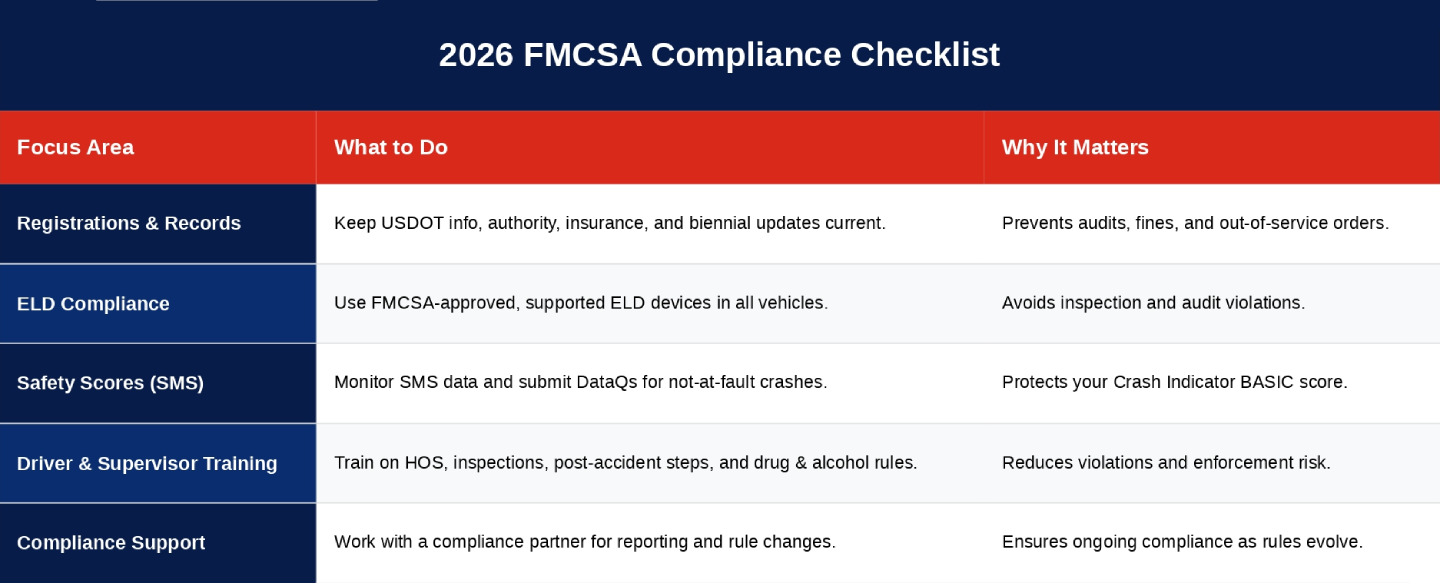
Here’s a practical compliance checklist to help you stay prepared for 2025 and beyond:
Keep Registrations and Records Up to Date
Ensure your USDOT information, operating authority, insurance filings, and biennial updates are current. Inaccurate or outdated records can lead to audits, fines, or even out-of-service orders.
Use Current, Approved ELD Technology
Verify that all vehicles are equipped with compliant, up-to-date ELDs. Older or unsupported devices can trigger violations during roadside inspections or audits.
Monitor and Protect Your Safety Scores
Regularly review your Safety Measurement System (SMS) data. If you are involved in an eligible crash that was not your fault, submit a Request for Data Review through FMCSA’s Crash Preventability Determination Program to help protect your Crash Indicator BASIC score.
Train Drivers and Supervisors
Make sure drivers understand Hours of Service rules, inspection requirements, and post-accident procedures. Supervisors should be trained on drug and alcohol regulations, including reasonable suspicion requirements.
Work With a Compliance Partner
FMCSA rules are becoming more complex. Partnering with a compliance expert like DOT Compliance Group can help you manage registration, reporting, and ongoing changes—so nothing falls through the cracks.
Get Support with FMCSA Compliance
Tools and Resources for Easy FMCSA Filing
Drug & Alcohol Clearinghouse
The Clearinghouse is required for all DOT-regulated employers and drivers. It’s used for pre-employment and annual queries, reporting violations, and follow-up testing
Internal Compliance Checklists
Maintaining your own checklists for inspections, driver qualification files, and drug and alcohol testing requirements can help ensure nothing is missed throughout the year.
Compliance Support Services
Working with DOT Compliance Group, a trusted compliance partner, can streamline filings, reporting, and monitoring. Expert support helps take the guesswork out of FMCSA regulations and keeps your operation audit-ready year-round.
Common Mistakes to Avoid with New FMCSA Rules
As FMCSA rules continue to change, violations can happen to carriers because of simple, avoidable mistakes. Here are some of the most common to watch out for:
- Relying on Outdated Information
Using old guidance, expired forms, or outdated processes can quickly put you out of compliance. - Overlooking English Proficiency Enforcement
Drivers not demonstrating reading/speaking ability may be placed out of service. - Poor Documentation and Digital Transition Errors
Migrate maintenance, driver, and safety documents to FMCSA-approved digital platforms and devices.


0 Comments