Blogs

March 30, 2023

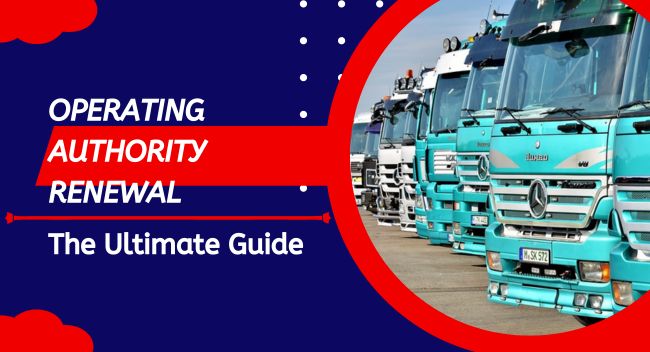
Truck Operating Authority Renewal Guide: Key Insights

Your operating authority is the ticket that allows you to function as a trucking company in the US. It could be the MC authority, the FF number, or the MX number. Depending on the capacity that you operate in your operating authority is going to differ. Applying for your operating authority is very easy. But operating authority renewal is going to be a little different. 

If your company operates as a motor carrier or trucking company or falls under any other regulated entity governed by the US Department of Transportation, you must ensure that you renew with utmost care and precision. If you want to change the name of your company or its address or any other related details in the record of the authorities, you are going to update your USDOT and operating authority record on time. The federal motor carrier safety administration requires all these entities to update their information every 2 years already. There are:

  • Routine updates
  • Biennial updates
  • Updates related to the activation and deactivation of the US DOT number
  • Reactivation of the US DOT number

Your routine USDOT number updates and biennial updates are two of the most common updates that you will have to perform. Failure to complete your biennial update may result in civil penalties of up to $1,000 per day. These can go up to $10,000 per day but may not exceed this amount.

Having said that, If you plan to make changes to your trucking company’s details or way of doing business, such as a change of address, you’ll need to undergo operating authority renewal or reapplication.

Renewing Your Operating Authority When Changing Your Company Name

Whether you are a motor carrier, a broker or a freight forwarder, updating your operating authority in case you want to change your official or commercial name requires you to fill out the OP–1 Series form. You will also have to pay a 14 dollar fee for this name change. The online application is going to require you to submit your credit card information and your USDOT pin as well. The online registration form is available for download.

However, you can continue with the online process as well which is usually the fastest of all. If you are filing for a name change, you will be given an option on the form that says the same thing. There are attached instructions that you will have to follow exactly as given on that page. You can either submit a web form or download it and send it to the federal body through fax or you can also post it through US mail. Remember, name changes will be made only when the authorities have all the required information and documentation with them.

Changing Your Company Address During Operating Authority Renewal

This is also a very critical thing to do. Whether it is your MC number, FF number, or any other operating authority, there are three ways to submit your address change request.

Online
The online method is the fastest. You can use the license and insurance system to request a change of address. The filing instructions will be given on the page and you will have to follow exactly what they say.

Email
You can also download the form which is the MCSA-5889 motor carrier records change form. Fill it out and upload it just as has been instructed on the website. You will receive a tracking number in your official / registered email inbox.

Through US Mail
This is probably the longest process because it takes around 6 to 8 weeks to complete. You can mail this information to the

U.S. Department of Transportation
Federal Motor Carrier Safety Administration
Attention: Office of Registration
1200 New Jersey Avenue, S.E.
Room W65-206
Washington, DC 20590

Using Fax
The same form can be sent to 972-402-5456. The complete form must contain the following information:

  • The MC number
  • The name of your company
  • The former and current addresses and telephone numbers of the company
  • Signature of the applicant or that of your representative

Activating Or Reactivating Your Operating Authority

Your MC/FF/MX number may require reactivation or reinstating if it has been inactive for long. You’re required to do the following:

You must file your proof of insurance along with your BOC-3 form with the FMCSA as this is the designation of process agents form.

If you are a motor carrier, and if you have an active USDOT number, you must make sure that it is up to date with the most correct and accurate contact information. To make sure that your request for the reinstatement of your operating authority is observed and acted upon, you will have to ensure that your USDOT number is active and not out of service.

You can submit your MCS-150 form with this reinstatement request to update your company-related information. If you are a passenger carrier, it is not possible for you to request the reinstatement of your operating authority if the authorities have placed you out of service considering you an imminent hazard.

This means that your safety rating was not satisfactory. You will have to reapply for your operating authority using the OP-1 application form and pay the application fee too which is $300.

Revoking Your Currently Active Operating Authority, Do People Do That?

Yes, people do that when they are in the process of shutting down their business or changing their company operations entirely. For example, if you want to suspend your interstate operations, you can request a voluntary revocation of your operating authority. You will have to check whether the status of your operating authority is showing active or inactive. Requesting a voluntary revocation is very easy. You just have to have your USDOT pin with you. There is the form OCE-46 that you will have to complete here. Keep in mind that you can reinstate your registration at any time in the future if you decide to start performing those operations or want to revert to your old business functions.

Conclusion

There is a lot that goes into operating authority renewal. There are a lot of details and several numbers and names that you will have to remember. This is exactly why dot compliance groups and third party administrators exist. You shouldn’t have to deal with all these complex formalities and extensive paperwork. You should be focusing on your business and thinking about how to grow it even further. It is time to choose a third party administrator for your compliance needs today.


FAQ

What Happens If You Fail a DOT Inspection?

If the vehicle or driver is deemed unsafe, they may be placed out of service, meaning the vehicle cannot operate until all violations are properly corrected.

Who decides which level of inspection to perform?

Both the Commercial Vehicle Safety Alliance (CVSA) and the Federal Motor Carrier Safety Administration have a part in DOT inspection levels. The CVSA develops the criteria and sets the procedures for every inspection level. The FMCSA establishes overall regulations and determines which vehicles must be inspected.

How often do DOT inspections happen?

DOT inspections can happen at any time. They most commonly happen during roadside stops and weigh stations. Carriers with higher risk, poor safety records, or hazardous material may be inspected more frequently.

What documents are required during an inspection?

Documents required during an inspection include but may not be limited to:

  • State driver’s license or commercial driver’s license
  • Medical examiner’s certificate
  • Record of duty status
  • Vehicle registrations
  • Periodic inspections document for all vehicles being operated
  • Shipping papers or bills of lading
  • Information for hazardous materials being transported
  • Proof of insurance

What are common DOT inspection violations?

According to the FMCSA, the 5 most cited roadside violations are:

  1. False Report of Driver’s Record of Duty Status: log falsification providing inaccurate or intentionally altered duty-status information.
  2. No Record of Duty Status (ELD Required): using a commercial vehicle without the required electronic logging device or valid time records.
  3. Inoperable Required Lamp: crucial lights (headlights, brake lights, turn signals, etc.) are not functioning properly.
  4. Operating a Commercial Motor Vehicle Without a Commercial Driver’s License (CDL)
  5. Operating a Commercial Motor Vehicle Without Proof of a Periodic Inspection: failure to meet FMCSA the maintenance standards of a required annual inspection.

Why is updating VMT important for compliance?

VMT is tracked to determine fuel tax obligations (Vehicle Miles Traveled Tax) used for road maintenance and improvements. Trucking companies must keep accurate records of VMT to ensure they pay the correct amount of taxes.

How often should VMT be updated?

For motor carriers VMT must be updated every two years along with the MCS-150 form for the Biennial Update.

Can VMT be tracked automatically with technology?

Yes, Electronic Legging Devices (ELDs), Fleet Management Apps, and Mileage Tracking Software are all technological advancements that can simplify the process of VMT tracking.

How does VMT affect taxes and fuel reporting?

Accurate VMT records help document mileage for business-related tax deductions, ensuring compliance with IRS regulations. It also supports fuel tax reporting by tracking the miles each vehicle travels in different jurisdictions, which is essential for state and federal fuel tax calculations. Proper tracking reduces errors, prevents penalties, and provides a clear record of operational costs.

How do I know when my Biennial Update is due?

  • Your filing schedule depends on the last two digits of your USDOT number. The last digit corresponds with what month the form needs to be filed in. January is 1, February is 2, March is 3, etc. The next to last digit determines the year (odd-numbered year or even numbered year). For example, DOT number 1234567 files their biennial update in July (7) of every even year (6). Contact us today to see if you’re due.

Does the Biennial Update cost money to file?

While you can file your Biennial Update yourself for no cost through FMCSA. The process can often be confusing and time-consuming. Our team can handle your filing for you, simplifying the process for you.

Do intrastate carriers need to file the update?

Yes, even if carriers stay within state lines, a biennial update is still needed for their USDOT number.

What happens if I miss my filing deadline?

  • Failure to complete biennial update to FMCSA can be subject to fines with a maximum penalty of $10,000. If your update is past due, you can still file it to restore your compliance status. Contact us today to file your form! https://dotcompliancegroup.com/bu-update/ 

What are the new FMCSA rules in 2025?

  1. Civil Penalty Amount Increases
  2. Drug & Alcohol Clearinghouse Becomes Exclusive Source for checking driver history.
  3. ELD Technology Required
  4. SMS (Safety Measurement System) Modernization
  5. Crash Preventability Determination Program Expanded

When do the 2025 FMCSA regulations take effect?

The confirmed dates these regulations take effect is May 30, June 23, October 1, 2025.

How can trucking companies prepare for these changes?

Regularly reviewing your Safety Measurement System (SMS) scores and maintaining personal checklists for inspections, driver qualification files, and drug and alcohol testing helps catch issues before they affect audits. Partnering with DOT Compliance Group streamlines filings, reporting, and ongoing monitoring, taking the guesswork out of FMCSA regulations and keeping your operation audit-ready year-round.

What Triggers a DOT Compliance Review?

A DOT compliance review is triggered when FMCSA wants to ensure a carrier is following safety regulations. Common triggers include high SMS safety scores, a history of crashes or violations, and previous noncompliance. Staying proactive with accurate records, driver files, and regular internal audits helps reduce the likelihood of a review.

Where can I get help with FMCSA filings?

DOT Compliance Group can assist with any help or questions you may have about FMCSA filings. Call 972-476-9962.

How long are violations kept on record?

According to the Clearinghouse rules, drug and alcohol violations remain in the FMCSA Clearinghouse for five years, provided all requirements (such as completing the return‑to‑duty process) have been met before that period ends.

What if an employer makes a mistake in reporting?

In practice, correcting an employer reporting error typically involves identifying the mistake in the database and then submitting a request for correction through the Clearinghouse portal or FMCSA procedures, so the record reflects accurate information. 

What are the penalties for non-compliance?

FMCSA rules allow civil penalties for non‑compliance, and separate authorities note that employers who fail to meet Clearinghouse requirements may face civil fines or criminal penalties under federal regulations.

Do trucking companies check the Clearinghouse?

Yes — trucking companies check the Clearinghouse as part of their hiring and compliance process. The FMCSA Clearinghouse is designed so employers can search a driver’s drug and alcohol violation records before permitting them to operate a commercial vehicle. Employers are required to conduct these queries for both prospective and current drivers as part of compliance.

0 Comments

Submit a Comment