
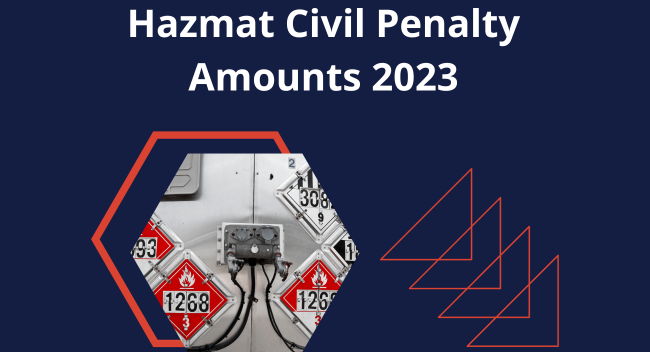
The civil penalty amounts for HazMat violations have been recently increased in 2023. Learn more about how you can stay compliant here.
The Pipeline and Hazardous Materials Safety Administration (PHMSA) is a division of the U.S. Department of Transportation (USDOT) responsible for regulating and ensuring the safe transportation of hazardous materials (HazMat).
The PHMSA plays a crucial role in increasing HazMat civil penalties to enforce compliance and deter potential violators, ultimately enhancing the safety of hazardous materials transportation.
Why Were the HazMat Civil Penalty Amounts Increased?

Growing arrow sign. Jeans style icon on white background.
The HazMat civil penalty amounts were increased due to the Federal Civil Penalties Inflation Adjustment Act of 1990 (FCPIAA). The increase was done to account for inflation and to preserve the penalties’ deterrent impact.
The FCPIAA requires federal agencies to periodically adjust their civil monetary penalties, ensuring they maintain a meaningful impact over time.
USDOT Agencies that Have Increased the Penalties
Beginning January 6, 2023, the following USDOT agencies have increased their respective civil penalty amounts by 1.07745 of the previous year’s penalty:
- Office of the Secretary (OST)
- Federal Aviation Administration (FAA)
- National Highway Traffic Safety Administration (NHTSA)
- Federal Motor Carrier Safety Administration (FMCSA)
- Federal Railroad Administration (FRA)
- Pipeline and Hazardous Materials Safety Administration (PHMSA)
- Maritime Administration (MARAD)
- Great Lakes St. Lawrence Seaway Development Corporation (GLS)
New HazMat Civil Penalty Amounts 2023
The following is a partial list of HazMat civil penalty amounts for the year 2023, along with their respective former amounts:
Maximum civil penalty amounts for hazardous materials violation
- Former: $89,678
- Current: $96,624
Maximum civil penalty amounts for hazardous materials violation
(resulting in death, serious illness, or severe injury to any person, or the substantial destruction of property)
- Former: $209,249
- Current: $225,455
Minimum civil penalty for violation of hazardous materials transportation law relating to training
- Former: $540
- Current: $582
Maximum civil penalty amounts for violation of hazardous materials transportation law relating to training
- Former: $89,678
- Current: $96,624
Violation by an individual or small business concern related to the transportation of hazardous materials
- Former: $14,950
- Current: $16,108
Violations of Hazardous Materials Regulations (HMRs) and Safety Permitting Regulations (packaging or container)
- Former: $89,678
- Current: $96,624
Minimum civil penalty for violations of the CRs (motor carrier or broker for transportation of hazardous wastes)
- Former: $23,915
- Current: $25,767
Maximum civil penalty for violations of the CRs (motor carrier or broker for transportation of hazardous wastes)
- Former: $47,829
- Current: $51,533
For a more comprehensive list, please check the 2023 USDOT final rule for civil penalty amounts.
What Are Considered Maximum Civil Penalty Amounts for Hazardous Materials Regulations?
The following are instances where the maximum HazMat civil penalty amounts are applicable:
- A person who knowingly violates a requirement of the Federal hazardous material transportation law or regulation that results in death, serious illness, or severe injury to any individual;
- A person who knowingly violates the design, manufacture, fabrication, inspection, marking, maintenance, reconditioning, repair, or testing of a package, container, or packaging component of a hazardous material

DOT Placards Displayed on the Rear of a Fuel Tanker
What Are Considered Minimum Civil Penalty Amounts for Hazardous Material Regulations?
The minimum civil penalty amounts for hazardous material regulations apply when a person is found to have:
- Failed to take corrective action in response to a notice of violation
- Violated a requirement to submit reports or pay fees
- Failed to obtain registration, certification, or approval required by the Federal hazardous material transportation law
- Violated any training requirement of the regulations
What Is Considered a Severe Injury Related to HazMat Violations?
Severe injury is any physical harm that causes temporary or permanent disability, disfigurement, extreme pain, or suffering. It can also include emotional distress and economic loss due to the injury.
For example, a severe injury could be the loss of an arm due to an explosion caused by improperly transporting hazardous materials or exposure to toxic pollutants from a HazMat accident.

Team of firefighters extinguished the blaze, flames, smoke close to the train tanker, which is dangerous.
What Is Considered Substantial Destruction of Property Related to HazMat Violations?
Substantial destruction of property is defined as significant damage to a person’s home, business, or other real property, causing an economic loss that is a substantial part of the value of the property.
For example, a HazMat accident could cause severe damage to a residential property, leading to large-scale repairs or even the demolition of the affected structure.
What Happens When a HazMat Violation Results in Death?
When a HazMat violation constitutes the death of a person, the responsible party could be subject to maximum HazMat civil penalty amounts as outlined in the 2023 USDOT final rule.
Additionally, a separate offense for criminal liability could apply in cases involving gross negligence or reckless disregard for the safety of others.
What Is Considered Special Permit or Approval Required Under the Federal HazMat Transportation Law?
A special permit or approval is required when a hazardous material does not meet all applicable requirements of the Federal hazardous material transportation law and/or regulations or is to be transported in a manner not authorized under the law or regulations.
For example, a special permit or approval could be required for the transportation of hazardous waste in large quantities or to transport certain types of explosives.
What Are Common Violations Against the Hazardous Material Regulations (HMR)?
Common violations against the Hazardous Material Regulations (HMR) include:
- Improper packaging: Failing to use appropriate packaging materials or methods to contain hazardous materials during transportation.
- Inadequate labeling: Not providing accurate, visible, and durable hazard labels and markings on packages containing hazardous materials.
- Insufficient documentation: Failing to provide complete and accurate shipping papers, including emergency response information and required certifications.
- Lack of employee training: Not providing mandatory training to employees involved in handling, transporting, or managing hazardous materials.
- Unauthorized transportation: Transporting hazardous materials without proper permits or authorization.
- Failure to comply with security requirements: Not adhering to the required security measures for the safe transportation of hazardous materials.
- Inadequate placarding: Failing to display the appropriate placards on vehicles transporting hazardous materials to indicate the risks associated with the cargo.
- Improper loading and segregation: Incorrectly loading hazardous materials or not segregating incompatible materials in a transport vehicle.
These violations can lead to heavy HazMat civil penalties, fines, and increased scrutiny from regulatory agencies. Compliance with HMR is essential to ensure the safety of people, property, and the environment.
Recent Safety Alert Related to Lithium Batteries Transportation for Electric Vehicles (EV)
The PHMSA issued a safety advisory notice in April 2023 regarding the risk of transporting electric vehicles (EVs) powered by lithium batteries.
The advisory emphasizes the responsibility of shippers to properly assess EVs and their respective lithium batteries for potential damage. Shippers are also reminded to observe the Hazardous Materials Regulations (HMR) 49 CFR Parts 171-180 for the safe transport of lithium batteries, including proper packaging and labeling.
Recent Safety Alert Related to DOT-111 Tank Cars in Flammable Liquid Service
The PHMSA also issued a safety advisory in March 2023 to upgrade DOT-111 tank cars to stay compliant with the latest safety standards for the transport of flammable liquids.
The advisory also reminds shippers to inspect their DOT-111 tank cars for any modifications or repairs, as well as to ensure that they are using the proper car type and its associated equipment for transporting their goods.
In addition, shippers should adhere to the requirements of 49 CFR Parts 171-180, especially with regard to the handling of hazardous materials.
Recent Safety Alert Related to Tank Cars Equipped with Aluminum Manway Covers
A safety advisory notice was released in March 2023 regarding the risks of tank cars with aluminum protective manway covers, especially when exposed to extreme heat. Aluminum manway covers are potentially prone to cracking or breaking during transport, which can lead to a hazardous materials incident.
Shippers and carriers are reminded to inspect their manway assemblies regularly and ensure they are equipped with steel protective housing covers.

Online training concept with icon design, vector illustration 10 eps graphic.
Quality HazMat Training Online from DOT Compliance Group
Compliance with the latest HazMat and USDOT regulations is vital for businesses that transport hazardous materials; otherwise, you run the risk of facing costly fines or other penalties.
At DOT Compliance Group, we provide comprehensive HazMat training to ensure that shippers comply with the current regulations and are well-prepared for any potential incident.
Contact us today to learn more about our HazMat training services and how we can help your business stay up-to-date on the latest regulations.

0 Comments