Blogs

January 7, 2022

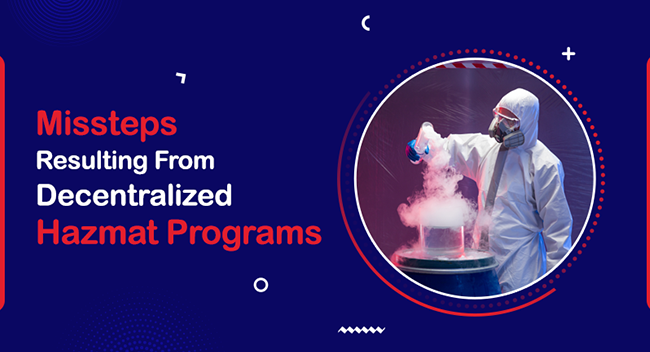
Avoiding Hazmat Pitfalls in Decentralized Programs

The United States Department of Transportation and FMCSA value the lives of the US population, hence, strict laws are put in place to curtail transport companies. Whether you are into the Hazmat transportation business or any other form of transportation, there is a need to stay compliant at all times to save your business from complications. Nevertheless, our focus in this article is on employers in the hazardous material transportation business.

As an employer in the hazmat transportation business, failing to adhere to compliance issues related to Hazmat transportation can result in a heavy blow on your organization, affecting many departments and employees. It is not uncommon for compliance in this area not to fall under the EHS manager’s or department’s control.

As experts in Hazmat programs, we have put together 11 common missteps that could result from decentralized Hazmat programs.

Misstep #1: Not being able to understand the differences in regulations between modes of transportation (airline, highway, railway, and pipeline)

Employees need to be able to apply modal-specific regulations. FedEx Express has a requirement that all hazmat shipments, domestic or international, must be prepared according to the International Air Transport Association’s Dangerous Goods Regulations. This is one of the most common errors and most people fail to realize this fact.

Misstep #2: Limiting access to shipping accounts to trained employees

This can be especially difficult for large facilities that have multiple departments and heads of different departments. It can be difficult to catch everyone who might be offering hazardous material to UPS/FedEx. It is difficult to find everyone who could ship hazardous material to UPS/FedEx. There should be a system that trains all those who may ship it, and then provides a gatekeeper to handle the shipment.

Misstep #3: Assuming that original suppliers are competent and reliable in supplying safety data sheets (SDSs) for shipping information

Sometimes the person who put together the sheet may not be as knowledgeable about the regulations as they should be. People responsible for hazardous materials must be able to create their shipping protocols from scratch and not rely on third parties.

Misstep #4: Inadvertently creating enforcement and inspection triggers

From an enforcement point of view, one of the biggest problems is not understanding the difference between air shipments and highway shipments. FAA is the agency that conducts the most hazardous material shipping-related inspections at shipper locations. Random inspections are mostly triggered by FAA’s Dangerous Goods Declarations at FedEx or UPS locations. Use exceptions as much as possible to avoid the declaration. The risk of an FAA inspection will be greatly reduced if you avoid the declaration.

Misstep #5: Incorrectly packing hazardous material shipments for return to suppliers

Many shipping/receiving personnel think that returning hazardous materials shipment shipments is as simple as re-offering the package with original labels and markings. These employees may not have been trained to be “hazmat shippers”. They might try to figure out how to get the shipment out the door quickly, which could be a costly mistake.

Misstep #6: Not training receivers on issues related to emergency response and proper identification

Safety and transportation could be affected by actions taken by receivers. Receivers must be able to identify hazardous materials incoming, including those marked with exceptions, salvage containers, radioactives, and temperature sensitive materials.

Misstep #7: Not having the right software, pre-approval, and/or contract for shipping hazardous materials

Some hazardous materials and carriers cannot be offered without pre-approval from the operator. FedEx Express, for example, requires that Shipper’s declarations for dangerous goods be prepared using approved software and comply with edit checks. FedEx Express and UPS also require pre-approval for all lithium metal battery UN3090 (all sizes).

Missteps #8: Not having administrative oversight over hazardous materials program (reporting, security, registration, recordkeeping, and inspection readiness)

While some hazmat shipping compliance issues do not directly relate to shipment preparation, they are administrative. This requires a department or person to take responsibility.

Misstep #9: It’s not about determining the “competency” of hazmat workers

The training is just one step of the hazmat programs process. Employers are responsible for determining competency, as they ultimately have to ensure that shipments comply with regulations. The best way to learn is to do it under the guidance of an experienced hazmat shipping professional for a time before being permitted to prepare your shipments.

Misstep #10: Incorrectly preparing hazardous material for self-transport, or hiring untrained couriers in order to move hazardous materials

This is the most common definition of “Materials of Trade”. The MOT exemption is often used and has many benefits in reducing regulatory requirements. However, there are some things you should be aware of: the MOT exception’s restrictions and requirements, the third-party transport exception, and personal liability that falls under personal vehicle use.

Misstep #11: Offering electronic, batteries, devices, and instruments that are mistakenly thought to be non-hazardous

Many hazardous materials, such as lithium batteries, magnets and instruments with compressed gas chambers, are not obvious.

As an EHS manager or director of a hazardous material transportation company, it is your duty to properly coordinate hazmat programs and double check that every compliance activity is followed to the core. Doing this correctly is essential to avoid any unwanted issues you are not ready to handle.

If you are an employer running a hazardous material transportation company, DOT Compliance Group is always happy to offer you exceptional services. Whether it is Hazmat registration, Hazmat permit (MCS-150B), or Hazmat transportation training for your employees, we have a team of professionals to handle all that for you.


FAQ

What Happens If You Fail a DOT Inspection?

If the vehicle or driver is deemed unsafe, they may be placed out of service, meaning the vehicle cannot operate until all violations are properly corrected.

Who decides which level of inspection to perform?

Both the Commercial Vehicle Safety Alliance (CVSA) and the Federal Motor Carrier Safety Administration have a part in DOT inspection levels. The CVSA develops the criteria and sets the procedures for every inspection level. The FMCSA establishes overall regulations and determines which vehicles must be inspected.

How often do DOT inspections happen?

DOT inspections can happen at any time. They most commonly happen during roadside stops and weigh stations. Carriers with higher risk, poor safety records, or hazardous material may be inspected more frequently.

What documents are required during an inspection?

Documents required during an inspection include but may not be limited to:

  • State driver’s license or commercial driver’s license
  • Medical examiner’s certificate
  • Record of duty status
  • Vehicle registrations
  • Periodic inspections document for all vehicles being operated
  • Shipping papers or bills of lading
  • Information for hazardous materials being transported
  • Proof of insurance

What are common DOT inspection violations?

According to the FMCSA, the 5 most cited roadside violations are:

  1. False Report of Driver’s Record of Duty Status: log falsification providing inaccurate or intentionally altered duty-status information.
  2. No Record of Duty Status (ELD Required): using a commercial vehicle without the required electronic logging device or valid time records.
  3. Inoperable Required Lamp: crucial lights (headlights, brake lights, turn signals, etc.) are not functioning properly.
  4. Operating a Commercial Motor Vehicle Without a Commercial Driver’s License (CDL)
  5. Operating a Commercial Motor Vehicle Without Proof of a Periodic Inspection: failure to meet FMCSA the maintenance standards of a required annual inspection.

Why is updating VMT important for compliance?

VMT is tracked to determine fuel tax obligations (Vehicle Miles Traveled Tax) used for road maintenance and improvements. Trucking companies must keep accurate records of VMT to ensure they pay the correct amount of taxes.

How often should VMT be updated?

For motor carriers VMT must be updated every two years along with the MCS-150 form for the Biennial Update.

Can VMT be tracked automatically with technology?

Yes, Electronic Legging Devices (ELDs), Fleet Management Apps, and Mileage Tracking Software are all technological advancements that can simplify the process of VMT tracking.

How does VMT affect taxes and fuel reporting?

Accurate VMT records help document mileage for business-related tax deductions, ensuring compliance with IRS regulations. It also supports fuel tax reporting by tracking the miles each vehicle travels in different jurisdictions, which is essential for state and federal fuel tax calculations. Proper tracking reduces errors, prevents penalties, and provides a clear record of operational costs.

How do I know when my Biennial Update is due?

  • Your filing schedule depends on the last two digits of your USDOT number. The last digit corresponds with what month the form needs to be filed in. January is 1, February is 2, March is 3, etc. The next to last digit determines the year (odd-numbered year or even numbered year). For example, DOT number 1234567 files their biennial update in July (7) of every even year (6). Contact us today to see if you’re due.

Does the Biennial Update cost money to file?

While you can file your Biennial Update yourself for no cost through FMCSA. The process can often be confusing and time-consuming. Our team can handle your filing for you, simplifying the process for you.

Do intrastate carriers need to file the update?

Yes, even if carriers stay within state lines, a biennial update is still needed for their USDOT number.

What happens if I miss my filing deadline?

  • Failure to complete biennial update to FMCSA can be subject to fines with a maximum penalty of $10,000. If your update is past due, you can still file it to restore your compliance status. Contact us today to file your form! https://dotcompliancegroup.com/bu-update/ 

What are the new FMCSA rules in 2025?

  1. Civil Penalty Amount Increases
  2. Drug & Alcohol Clearinghouse Becomes Exclusive Source for checking driver history.
  3. ELD Technology Required
  4. SMS (Safety Measurement System) Modernization
  5. Crash Preventability Determination Program Expanded

When do the 2025 FMCSA regulations take effect?

The confirmed dates these regulations take effect is May 30, June 23, October 1, 2025.

How can trucking companies prepare for these changes?

Regularly reviewing your Safety Measurement System (SMS) scores and maintaining personal checklists for inspections, driver qualification files, and drug and alcohol testing helps catch issues before they affect audits. Partnering with DOT Compliance Group streamlines filings, reporting, and ongoing monitoring, taking the guesswork out of FMCSA regulations and keeping your operation audit-ready year-round.

What Triggers a DOT Compliance Review?

A DOT compliance review is triggered when FMCSA wants to ensure a carrier is following safety regulations. Common triggers include high SMS safety scores, a history of crashes or violations, and previous noncompliance. Staying proactive with accurate records, driver files, and regular internal audits helps reduce the likelihood of a review.

Where can I get help with FMCSA filings?

DOT Compliance Group can assist with any help or questions you may have about FMCSA filings. Call 972-476-9962.

How long are violations kept on record?

According to the Clearinghouse rules, drug and alcohol violations remain in the FMCSA Clearinghouse for five years, provided all requirements (such as completing the return‑to‑duty process) have been met before that period ends.

What if an employer makes a mistake in reporting?

In practice, correcting an employer reporting error typically involves identifying the mistake in the database and then submitting a request for correction through the Clearinghouse portal or FMCSA procedures, so the record reflects accurate information. 

What are the penalties for non-compliance?

FMCSA rules allow civil penalties for non‑compliance, and separate authorities note that employers who fail to meet Clearinghouse requirements may face civil fines or criminal penalties under federal regulations.

Do trucking companies check the Clearinghouse?

Yes — trucking companies check the Clearinghouse as part of their hiring and compliance process. The FMCSA Clearinghouse is designed so employers can search a driver’s drug and alcohol violation records before permitting them to operate a commercial vehicle. Employers are required to conduct these queries for both prospective and current drivers as part of compliance.

0 Comments

Submit a Comment