

Blogs

June 1, 2022

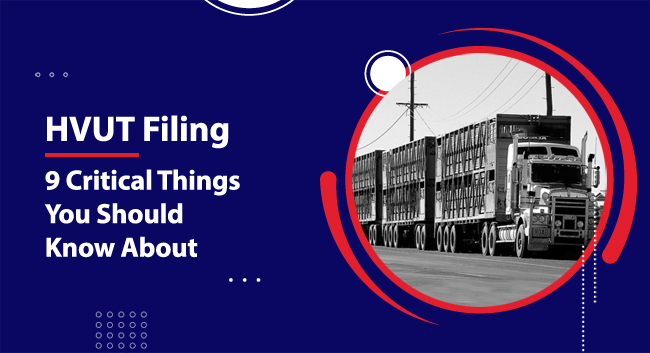
9 Critical Things You Should Know About HVUT Filing

The HVUT is your heavy vehicle use tax. It is Form 2290 that you have to file by August 31st every year. If you have a registered motor vehicle that has a gross weight either equal to or more than 55,000 LBS, and if you operate the same on any US public highways, it would be considered a taxable vehicle. This means that you must pay the heavy vehicle use tax on it. It is an annual tax that is paid using Form 2290. It is necessary if you want to keep your commercial trucks operating throughout the year on all the public highways that you use to carry out your interstate operations.

There are a few things that you should understand about the HVUT in addition to how it is calculated, and what are the various fines and penalties if you fail to file it on time. The enforcement of the HVUT filing and what it means to e-file for the same, among many other things are also essential. Let’s find out what those things are so that you can stay compliant and do not have to face any difficulties when carrying out your daily business functions.

1. Calculating Your HVUT

Your heavy vehicle use tax is calculated on the number of taxable vehicles that you own and operate. The taxable weight of the vehicle will also be considered. The gross taxable weight is usually determined by

  • Considering the empty gross vehicle weight 
  • The unloaded weight of any attached trailers that are usually used in combination with the vehicle to carry out your interstate operations 
  • Considering the heaviest load that is customarily transported using that vehicle

For example, if you have a vehicle that has a gross vehicle weight rating of 55,000 lbs, you will have to pay a fee using Form 2290. If you have any additional weight that goes above 55,000 lbs, that will be subject to $22 per every 1,000 LBS. So this goes up to a maximum of 75,000 lbs.

2. Understanding The Due Date Of This Tax

The HVUT taxes or fees are usually collected annually. So far there hasn’t been any change in the due date which is August 31st every year. For any taxable vehicles that have operated for the entire period which is July 1st, 2020 to June 30th, 2021, you as the owner of that vehicle will have to fill the form 2290 and submit the same by the due date which is August 31st.

3. How Do You Pay Your HVUT?

The filing of your HVUT is very simple. The best way is to get in touch with your third-party administrator and let them do the needful. However, you can find Form 2290 online as well. You can do the filing all by yourself but then that is going to take a lot of time. Whether you are a domestic transportation company or an international entity, you must submit Form 2290 and Schedule 1 before August 31st which is the deadline. 

4. Enforcement Of The Heavy Vehicle Use Tax

Do you know that there are bodies such as the IRS, state and local agents, and also the FHWA that work together to identify any heavy vehicle use tax evasions? So yes, it is not going to be a good idea if you are thinking about skipping the payment of this tax. Remember, whenever you file for this tax, you will be issued a copy of Schedule 1 which is stamped and returned to you by the IRS. This is your proof of payment. If you have defaulted on your payment due to any reason, there will be a late payment charge of 4.5% on the total HVUT that is due on your vehicle for that period of time. This will be due monthly for up to 5 months and this is going to amount to a massive figure. 

5. Filing Your HVUT – Extending Your IRS Timeline Or Filing It After The Due Date

Can you do that? Can you really file your HVUT after the due date has gone? According to law, there are penalties and fines that you will have to pay if you fail to file this return on time. But there are also penalties if you file any false or fraudulent returns. These penalties and fines will be in addition to the interest that you have to pay on late payments. The penalty for late filing however will not be imposed if you have reasonable cause for not filing it in the first place. If you can prove to the governing body that there was a genuine reason for you not being able to pay your tax on time, you will be allowed to file your tax after the due date. All you have to do is attach an explanation with the return and show a reasonable cause.

6. HVUT And E-Filing 

E-filing is just filing these taxes with the IRS through the internet. Electronic filing is very safe and your TPA is going to do the same thing for you. A lot of people think that a more private way to send your tax returns to the IRS is through the internet which is quite right. This is where your third-party administrator is going to come in. You don’t have to do all the calculations by yourself or file for your HVUT on the official IRS website. If you fill out any form incorrectly, it may be rejected. If you’re doing it for the first time, you are probably not aware of what all documentation is required to successfully file it in the first place. So yes, whether you decide to go for traditional filing or e-filing, get in touch with your third-party administrator to get the needful done.

7. Not The Owner Of The Vehicle From The Start. What Do You Do?

So what do you do if you are a new owner of an already registered vehicle? What do you do when that previous owner did not pay any taxes on the vehicle that you own right now? The current owner will be liable for the total tax for the entire tax period. This is only to the extent that has not been paid by the previous owner. As the current owner, you will be required to file Form 2290. You must pay the due amount by the last day of the month following the month when you received the notification from the IRS that the taxes due on your vehicle have not been paid by the previous owner.

8. What Is Credit?

You will get a five-digit pin that is going to serve as an electronic signature for your 2290 Form. This will help you in your tax filing. You are allowed to choose any random series of five numbers excluding any letters or symbols. The IRS is going to issue this to you and the same will be used to verify any of your company officials who are going to provide this code to them when connecting with them in case of any queries.

9. The Purpose Of Form 2290

In the end, the purpose of form 2290 is to allow you to file for your HVUT. It will help you figure out and pay the tax amount that is due on your vehicle. You can also claim suspension from the tax if your vehicle has run less than 5,000 miles during the period. If you own an agricultural vehicle and it has run less than 7,500 miles, you can again claim a tax suspension.

So There You Go

There is a lot to understand about the heavy vehicle use tax. As a trucking company or logistics enterprise, it is not going to be easy for you to keep track of all these little details in addition to the various compliance requirements, tax due dates, permits, licenses, and other documentation that is required to keep you compliant in this sector. This is where you should associate with a dependable third-party administrator. They let you do your business in peace. They manage all your compliance requirements and keep you operational and away from any fines and penalties throughout the year.
FAQ

What Happens If You Fail a DOT Inspection?

If the vehicle or driver is deemed unsafe, they may be placed out of service, meaning the vehicle cannot operate until all violations are properly corrected.

Who decides which level of inspection to perform?

Both the Commercial Vehicle Safety Alliance (CVSA) and the Federal Motor Carrier Safety Administration have a part in DOT inspection levels. The CVSA develops the criteria and sets the procedures for every inspection level. The FMCSA establishes overall regulations and determines which vehicles must be inspected.

How often do DOT inspections happen?

DOT inspections can happen at any time. They most commonly happen during roadside stops and weigh stations. Carriers with higher risk, poor safety records, or hazardous material may be inspected more frequently.

What documents are required during an inspection?

Documents required during an inspection include but may not be limited to:

  • State driver’s license or commercial driver’s license
  • Medical examiner’s certificate
  • Record of duty status
  • Vehicle registrations
  • Periodic inspections document for all vehicles being operated
  • Shipping papers or bills of lading
  • Information for hazardous materials being transported
  • Proof of insurance

What are common DOT inspection violations?

According to the FMCSA, the 5 most cited roadside violations are:

  1. False Report of Driver’s Record of Duty Status: log falsification providing inaccurate or intentionally altered duty-status information.
  2. No Record of Duty Status (ELD Required): using a commercial vehicle without the required electronic logging device or valid time records.
  3. Inoperable Required Lamp: crucial lights (headlights, brake lights, turn signals, etc.) are not functioning properly.
  4. Operating a Commercial Motor Vehicle Without a Commercial Driver’s License (CDL)
  5. Operating a Commercial Motor Vehicle Without Proof of a Periodic Inspection: failure to meet FMCSA the maintenance standards of a required annual inspection.

Why is updating VMT important for compliance?

VMT is tracked to determine fuel tax obligations (Vehicle Miles Traveled Tax) used for road maintenance and improvements. Trucking companies must keep accurate records of VMT to ensure they pay the correct amount of taxes.

How often should VMT be updated?

For motor carriers VMT must be updated every two years along with the MCS-150 form for the Biennial Update.

Can VMT be tracked automatically with technology?

Yes, Electronic Legging Devices (ELDs), Fleet Management Apps, and Mileage Tracking Software are all technological advancements that can simplify the process of VMT tracking.

How does VMT affect taxes and fuel reporting?

Accurate VMT records help document mileage for business-related tax deductions, ensuring compliance with IRS regulations. It also supports fuel tax reporting by tracking the miles each vehicle travels in different jurisdictions, which is essential for state and federal fuel tax calculations. Proper tracking reduces errors, prevents penalties, and provides a clear record of operational costs.

How do I know when my Biennial Update is due?

  • Your filing schedule depends on the last two digits of your USDOT number. The last digit corresponds with what month the form needs to be filed in. January is 1, February is 2, March is 3, etc. The next to last digit determines the year (odd-numbered year or even numbered year). For example, DOT number 1234567 files their biennial update in July (7) of every even year (6). Contact us today to see if you’re due.

Does the Biennial Update cost money to file?

While you can file your Biennial Update yourself for no cost through FMCSA. The process can often be confusing and time-consuming. Our team can handle your filing for you, simplifying the process for you.

Do intrastate carriers need to file the update?

Yes, even if carriers stay within state lines, a biennial update is still needed for their USDOT number.

What happens if I miss my filing deadline?

  • Failure to complete biennial update to FMCSA can be subject to fines with a maximum penalty of $10,000. If your update is past due, you can still file it to restore your compliance status. Contact us today to file your form! https://dotcompliancegroup.com/bu-update/ 

What are the new FMCSA rules in 2025?

  1. Civil Penalty Amount Increases
  2. Drug & Alcohol Clearinghouse Becomes Exclusive Source for checking driver history.
  3. ELD Technology Required
  4. SMS (Safety Measurement System) Modernization
  5. Crash Preventability Determination Program Expanded

When do the 2025 FMCSA regulations take effect?

The confirmed dates these regulations take effect is May 30, June 23, October 1, 2025.

How can trucking companies prepare for these changes?

Regularly reviewing your Safety Measurement System (SMS) scores and maintaining personal checklists for inspections, driver qualification files, and drug and alcohol testing helps catch issues before they affect audits. Partnering with DOT Compliance Group streamlines filings, reporting, and ongoing monitoring, taking the guesswork out of FMCSA regulations and keeping your operation audit-ready year-round.

What Triggers a DOT Compliance Review?

A DOT compliance review is triggered when FMCSA wants to ensure a carrier is following safety regulations. Common triggers include high SMS safety scores, a history of crashes or violations, and previous noncompliance. Staying proactive with accurate records, driver files, and regular internal audits helps reduce the likelihood of a review.

Where can I get help with FMCSA filings?

DOT Compliance Group can assist with any help or questions you may have about FMCSA filings. Call 972-476-9962.

How long are violations kept on record?

According to the Clearinghouse rules, drug and alcohol violations remain in the FMCSA Clearinghouse for five years, provided all requirements (such as completing the return‑to‑duty process) have been met before that period ends.

What if an employer makes a mistake in reporting?

In practice, correcting an employer reporting error typically involves identifying the mistake in the database and then submitting a request for correction through the Clearinghouse portal or FMCSA procedures, so the record reflects accurate information. 

What are the penalties for non-compliance?

FMCSA rules allow civil penalties for non‑compliance, and separate authorities note that employers who fail to meet Clearinghouse requirements may face civil fines or criminal penalties under federal regulations.

Do trucking companies check the Clearinghouse?

Yes — trucking companies check the Clearinghouse as part of their hiring and compliance process. The FMCSA Clearinghouse is designed so employers can search a driver’s drug and alcohol violation records before permitting them to operate a commercial vehicle. Employers are required to conduct these queries for both prospective and current drivers as part of compliance.

0 Comments

Submit a Comment